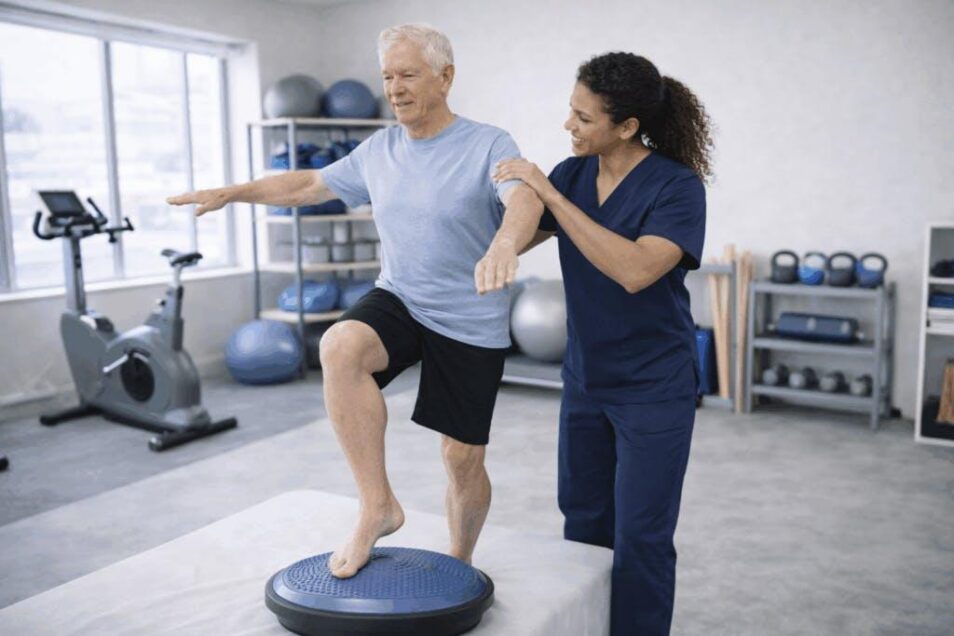
When we think about staying healthy as we age, we often focus on things like heart health, nutrition, and staying active. But there’s another important question to ask: If you lost your balance today, how confident are you that your body could recover?
Fall prevention isn’t just about being careful. Strength, balance, mobility, coordination, and confidence all play a role in keeping you steady on your feet. In honor of Fall Prevention Awareness Month, Full Distance Physical Therapy & Wellness put together a simple at-home check to help you think about how your body is moving today—and where you may have opportunities to become stronger for your future.
Before You Begin
This is not a diagnostic fall-risk assessment and should not replace an evaluation by a healthcare professional. Only try movements you feel safe performing. Have a sturdy counter or chair nearby for support, and stop if you experience pain, dizziness, significant unsteadiness, or feel unsafe.
The At-Home Fall Prevention Check
Answer YES or NO to each question. Give yourself one point for every YES.
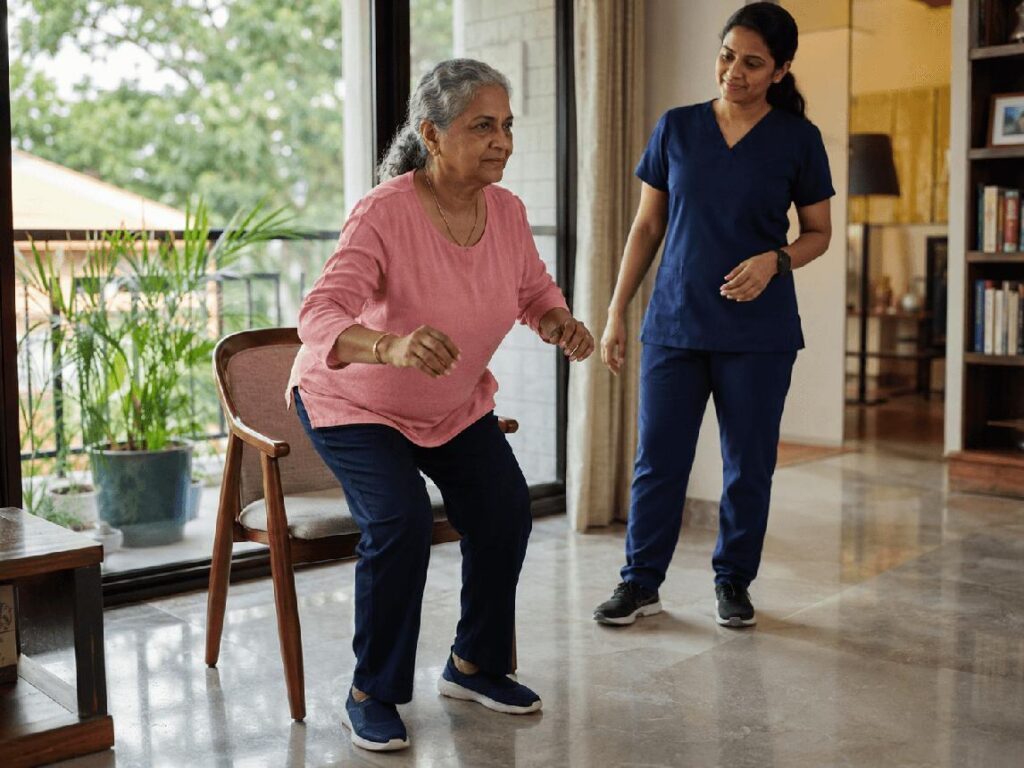
1. Do you use your hands to push yourself up from a standard chair?
Try standing from a firm chair without using your hands.
YES ☐ NO ☐
Regularly needing your arms for assistance may be a sign that your lower-body strength could use some attention.
2. Is it difficult to stand on one leg for 10 seconds?
Stand near a sturdy counter for safety and try each side.
YES ☐ NO ☐
Single-leg balance is used constantly during everyday activities—including walking and climbing stairs.
3. Do you feel unsteady when walking on grass, gravel, hills, or other uneven surfaces?
YES ☐ NO ☐
Real life doesn’t happen on perfectly flat floors. Your body needs to be able to adapt to changing surfaces.
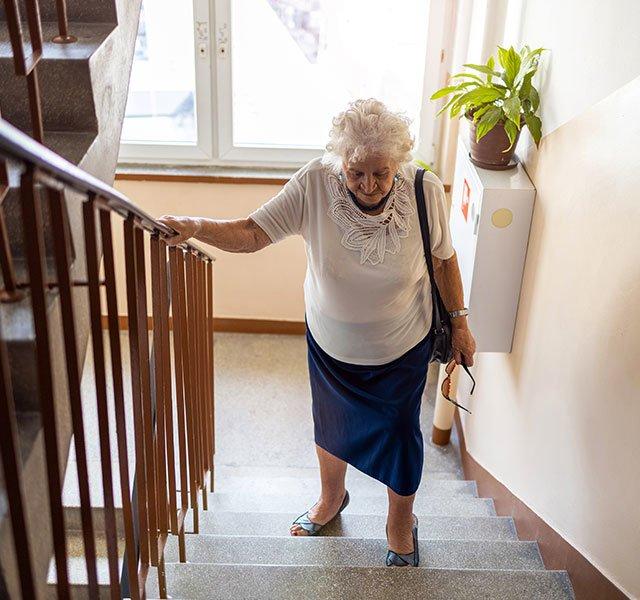
4. Do you regularly need the handrail to get up or down stairs?
YES ☐ NO ☐
Using a railing for safety is always a good idea. However, feeling physically unable to manage stairs without pulling yourself along may indicate an opportunity to improve leg strength, balance, or mobility.
5. Is getting down to the floor—and back up again—difficult?
YES ☐ NO ☐
Getting up from the floor requires a combination of strength, mobility, balance, and coordination. It is also an important ability to maintain in case you ever do experience a fall.
6. Do you frequently grab furniture, walls, or countertops when walking around your home?
YES ☐ NO ☐
“Furniture walking” can sometimes happen gradually, so you may not even realize how often you are doing it.
7. Have you noticed yourself taking shorter steps, shuffling, or moving more cautiously than you used to?
YES ☐ NO ☐
Changes in the way you walk are worth paying attention to—especially if they are new or worsening.
8. Have you fallen, stumbled, or had a close call within the past year?
YES ☐ NO ☐
A near-fall counts! Catching yourself on a counter, tripping but recovering, or suddenly needing someone else for support can all be useful warning signs.
9. Do you avoid certain activities because you are worried you might fall?
YES ☐ NO ☐
Fear of falling can sometimes lead people to move less. Unfortunately, less movement can contribute to further losses in strength and confidence.
10. Do you feel weaker or less confident in your balance than you did a year ago?
YES ☐ NO ☐
You know your body. A noticeable change in strength, mobility, or confidence is worth paying attention to.
How Did You Score?
0–1 YES Answers: Keep Building for the Future
Great! Your answers suggest you’re not noticing many of the warning signs included in this informal self-check.
That doesn’t mean balance and strength training should stop. Maintaining muscle, mobility, and balance can help you continue doing the activities you love and remain active and independent. Consider: Group Fitness, Personal Training, and regular physical activity that continues to challenge your strength, balance, mobility, and endurance. The goal isn’t just to be strong today—it’s to strengthen yourself for your future.
2–3 YES Answers: Build a Stronger Foundation
A few “yes” answers may be a sign that it’s time to take a more proactive approach to your strength, balance, and mobility.
This can be a great time to consider a combination of Physical Therapy and Personal Training. A Physical Therapist can evaluate specific areas of weakness, balance deficits, mobility restrictions, gait concerns, or movement patterns that may be contributing to your difficulties.
Personal Training can then complement that care by helping you continue to build strength, endurance, balance, and confidence through a safe and progressive exercise program.
At Full Distance, these services can work together to help you address current limitations while building the strength you need for the future. You don’t have to wait until you’ve experienced a fall to take action.
4+ YES Answers: Consider a Physical Therapy Evaluation
If several of these questions sounded familiar—especially if you have experienced a fall, significant balance changes, difficulty walking, pain, dizziness, or a noticeable decline in mobility—it may be time to schedule a Physical Therapy evaluation. A Physical Therapist can evaluate your strength, gait, balance, mobility, and other factors that may be contributing to your difficulties. From there, your therapist can develop an individualized plan based on your specific needs and goals.
As your strength, mobility, and confidence improve, Personal Training and Group Fitness can also be excellent ways to continue building on your progress.
One Important Exception
Your score isn’t the only thing that matters.
Even if you only answered YES to one question, consider contacting a healthcare professional if that answer involves a recent fall, a sudden or unexplained change in your balance or walking, dizziness, fainting, new weakness, or another concerning symptom.
Fall Prevention Is More Than Balance Exercises
If our at-home check uncovered a few areas of concern, the solution may involve more than simply practicing standing on one leg. The CDC’s Compendium of Effective Fall Interventions describes both single interventions and multifaceted interventions for fall prevention. A single intervention addresses a specific fall risk factor. For example, someone experiencing gait and balance difficulties may benefit from Physical Therapy. The CDC categorizes single interventions into areas including exercise, home modification, and clinical interventions. A multifaceted intervention addresses multiple fall risk factors. This approach may involve assessing an individual’s specific risk factors and developing an intervention plan tailored to those needs.
Why does that matter? Because your reason for being at risk of falling may be completely different from someone else’s. One person may need to improve leg strength. Another may have difficulty navigating their bathroom. Someone else may have problems with balance, walking, or safely completing everyday activities. At Full Distance Physical Therapy & Wellness, Physical Therapy and Occupational Therapy can approach these challenges from different—but complementary—angles.
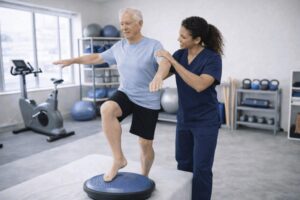
Physical Therapy: Strengthen How You Move
If weakness, poor balance, difficulty walking, or decreased mobility is contributing to your fall risk, Physical Therapy may be an important place to start.
Depending on your individual needs, a Physical Therapist can evaluate and address areas such as:
- Balance and stability
- Lower-body and core strength
- Walking and gait
- Mobility and range of motion
- Navigating stairs and uneven surfaces
- Transfers, such as getting up from a chair
- Getting down to and back up from the floor
- Mobility-device needs and proper use
Your Physical Therapist can then create an individualized program designed to improve the areas where you need the most support.
The CDC’s STEADI approach also recognizes gait, strength, and balance problems as modifiable fall-risk factors and includes appropriate exercise and Physical Therapy interventions as part of fall-prevention care.

Occupational Therapy: Make Everyday Life Safer
Sometimes the concern isn’t only how your body moves—it’s how safely and confidently you’re able to complete the activities that make up your everyday life. That’s where Occupational Therapy can be especially valuable. An Occupational Therapist can look at the tasks you perform every day and the environment in which you’re performing them.
Depending on your individual needs, OT may help address:
- Getting into and out of the shower or bathtub
- Dressing and other activities of daily living
- Navigating your home safely
- Bathroom and bedroom safety
- Carrying out everyday household activities
- Recommendations for adaptive equipment
- Home modifications that can make daily activities safer
- Functional limitations that may contribute to fall risk
The CDC’s fall-prevention resources include home assessment and home-modification strategies as part of fall prevention, and Occupational Therapy can play an important role in identifying functional and environmental challenges.
Sometimes the Best Approach Is a Combination
Maybe your balance needs work and getting into your shower has become difficult. Maybe you’ve lost leg strength and you’re no longer confident carrying laundry through your home. Maybe you’ve experienced a fall and aren’t sure whether the biggest concern is your strength, your mobility, your environment—or a combination of several factors. That’s why looking at the whole person matters. A multifaceted approach to fall prevention can identify multiple risk factors and create a plan based on your individual needs.
At Full Distance, that plan may include Physical Therapy, Occupational Therapy, Personal Training, Assisted Stretch, Group Fitness, or a combination of services depending on your needs and where you are in your wellness journey.
Don’t Wait for a Fall to Start Thinking About Fall Prevention
Fall prevention is really about something much bigger than avoiding falls. It’s about being able to:
- Get out of a chair.
- Climb the stairs.
- Walk through your yard.
- Get down on the floor—and get back up.
- Travel.
- Exercise.
- Play with your grandchildren.
- And continue doing the things that make your life yours.
You don’t need to wait until after a fall to find out where you could become stronger.
At Full Distance Physical Therapy & Wellness, our team can help identify areas that may be limiting your strength, balance, mobility, safety, or independence and help you determine the right next step. Whether that’s Physical Therapy, Occupational Therapy, Personal Training, Assisted Stretch, or Group Fitness, we’re here to help you keep moving forward. Don’t just prevent a fall. Strengthen yourself for your future.
FAQ
Under Virginia law, Direct Access allows you to receive treatment by a physical therapist for 60 days without a prescription from your doctor. This allows you to start receiving treatment more quickly while we handle contacting your physician.
Yes, Full Distance offers in-home care.
No. Fall prevention is most valuable before a fall occurs. If you’ve noticed changes in your strength, balance, mobility, or confidence, being proactive can help identify areas to work on now. At Full Distance Physical Therapy & Wellness in Purcellville, our team can help determine whether Physical Therapy, Occupational Therapy, Personal Training, or another wellness service may be an appropriate next step.
There isn’t one specific age when fall prevention should begin. Building and maintaining strength, balance, mobility, and coordination throughout adulthood can help prepare your body for the future. As we age, maintaining muscle and balance becomes increasingly important, so being proactive before you notice significant changes can make a difference. Fall prevention isn’t just for older adults or people who have already fallen—it’s about developing the strength and confidence to stay active and independent throughout your life.
At Full Distance, we like to think of fall prevention as training for your future—not waiting for a problem to occur.
Yes! Full Distance Physical Therapy & Wellness offers in-home fall risk assessments to help identify factors that may be affecting your safety and independence. Our team can assess your mobility and function within your actual home environment and identify potential areas of concern. Depending on your individual needs, we can also provide recommendations for fall prevention strategies, home modifications, adaptive equipment, and appropriate Physical or Occupational Therapy interventions to help you feel safer and more confident at home.